 AETHERIUM
What is AI Police Surveillance?
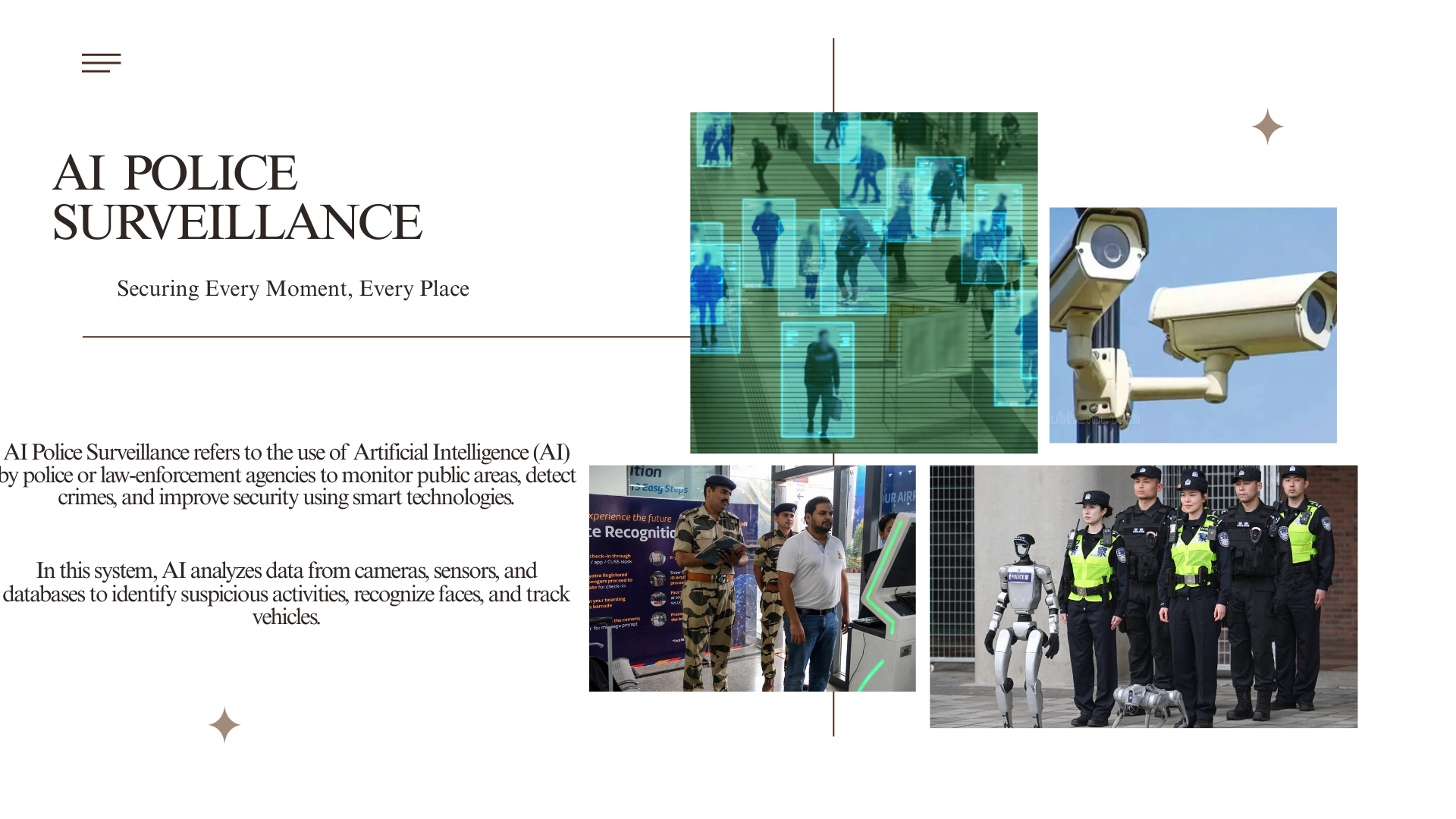
AI Police Surveillance is the use of intelligent systems to enhance law enforcement capabilities. Unlike traditional CCTV cameras, AI surveillance systems can:
Recognize faces and vehicles in real-time.
Detect suspicious behavior automatically.
Alert authorities about potential threats instantly.
How AI Police Surveillance Works
Smart Cameras and Sensors 📹
Cameras capture high-resolution video in public spaces, roads, and sensitive areas.
Sensors detect unusual movements or behaviors.
Facial Recognition & Object Detection 🧠
AI algorithms can identify faces, vehicles, license plates, and objects in real-time.
Helps track suspects or find missing persons quickly.
Behavior Analysis ⚡
AI detects abnormal patterns, such as loitering, running, or crowd formation.
Alerts police to intervene before a situation escalates.
Predictive Policing 🔮
AI analyzes historical crime data to predict potential crime locations and times.
Assists law enforcement in deploying officers strategically.
Centralized Monitoring & Alerts 📡
Data from multiple cameras and sensors is sent to a control center.
AI highlights suspicious activities and sends alerts to patrol units
Analyze patterns and trends to predict crime hotspots.
These systems combine computer vision, deep learning, and data analytics to provide actionable intelligence, allowing police departments to prevent crimes before they happen.
Applications of AI Police Surveillance
Urban Safety and Traffic Monitoring 🚦
Detects traffic violations, accidents, and congestion.
Improves traffic management and reduces road-related crimes.
Crime Prevention and Detection 🔍
Identifies shoplifting, vandalism, or assaults in real-time.
Speeds up investigations with automated evidence collection.
Public Event Security 🎉
Monitors large gatherings, concerts, and sports events for safety threats.
Helps prevent stampedes, fights, or terrorist activities.
Missing Persons and Amber Alerts 🧒
AI facial recognition can quickly locate missing children or vulnerable individuals.
Smart City Integration 🌆
Integrates surveillance with city management systems for real-time alerts and emergency response.
Advantages of AI Police Surveillance
Real-Time Monitoring ⏱️ – Instant alerts for suspicious behavior.
Enhanced Accuracy 🎯 – Reduces human error in monitoring.
Crime Prediction 🔮 – Helps law enforcement proactively prevent incidents.
Resource Optimization 👮 – Efficient deployment of police personnel.
Evidence Collection 📁 – Automatically records and archives incidents for investigations.
Challenges
Privacy Concerns 🔒 – Continuous surveillance may raise public privacy issues.
High Cost 💰 – Installing AI-enabled cameras and infrastructure is expensive.
Data Security 🛡️ – Large volumes of sensitive data must be protected from cyberattacks.
Bias in AI Algorithms ⚖️ – AI may sometimes misidentify individuals or groups due to biased datasets.
Maintenance and Upgrades 🛠️ – Systems require regular updates and technical support.
Future of AI Police Surveillance
Integration with Drones and Robotics 🛸🤖
AI-powered drones can monitor large areas and respond faster to incidents.
Predictive Crime Prevention 🔮
Advanced AI models may predict crimes hours or days in advance.
Smart City Networks 🌆📡
Connected systems that combine traffic, surveillance, and emergency services.
Ethical AI and Privacy Safeguards 🔒
Development of AI that respects civil liberties while maintaining security.
AI-Powered Analytics Dashboards 📊
Real-time data visualization for decision-making and policy planning.