 AETHERIUM
🕶️ AR, VR & Spatial Computing: The Future of Immersive Technology
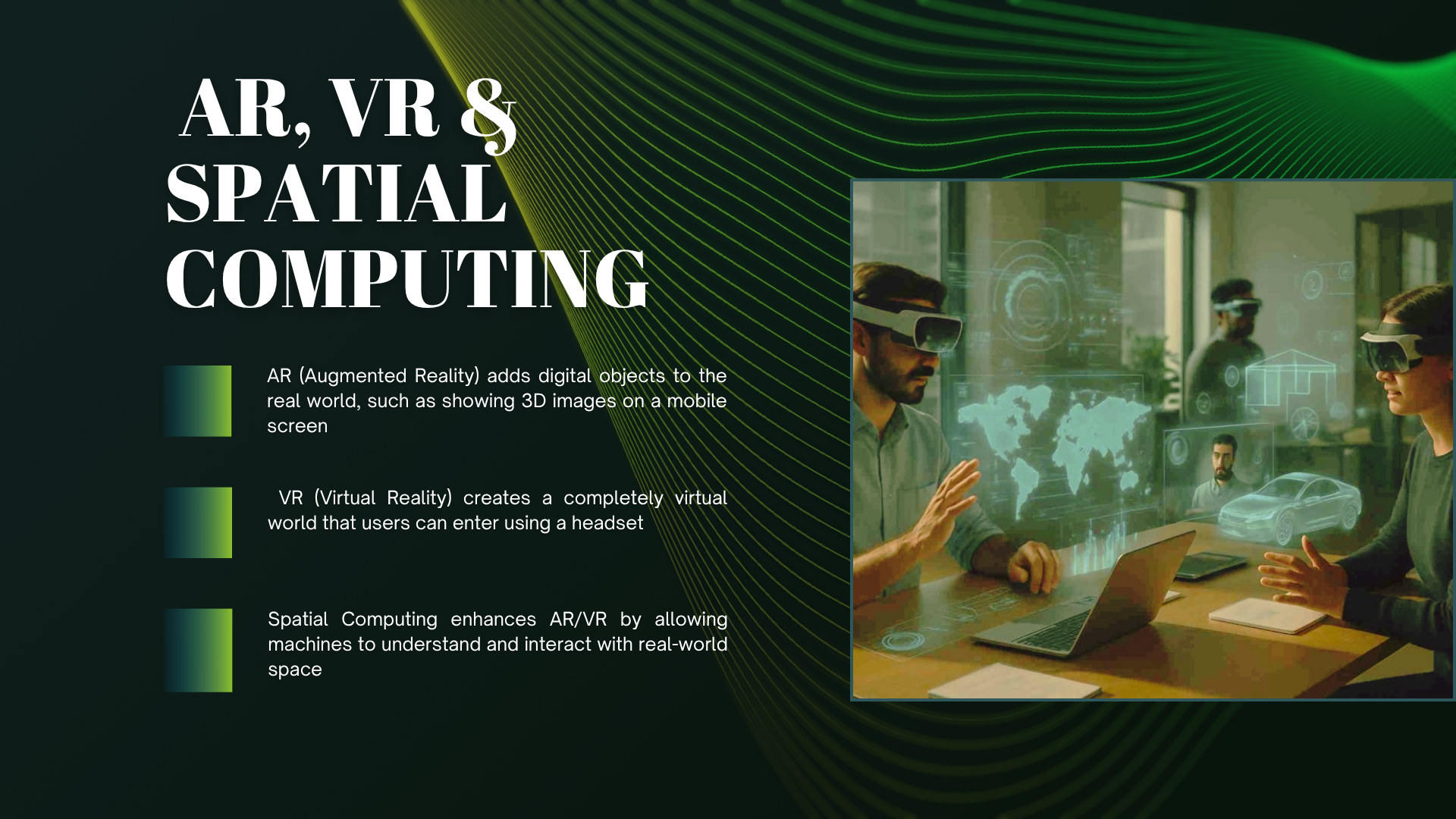
AR, VR, and Spatial Computing are advanced technologies that are changing the way humans interact with the digital and physical world 🌐. These technologies are creating immersive experiences that are widely used in gaming, education, healthcare, training, and future smart systems 🚀.
🟡 Augmented Reality (AR)
Augmented Reality (AR) is a technology that adds digital objects, images, or information to the real world 📱. In AR, users can still see the real environment, but it is enhanced with virtual elements. For example, 3D objects can appear on a mobile screen or directions can be shown in real time. AR is commonly used in mobile apps, shopping experiences, education tools, and navigation systems.
🔵 Virtual Reality (VR)
Virtual Reality (VR) creates a completely digital environment that replaces the real world 🕶️. Users wear VR headsets to enter a fully immersive virtual space where they can interact with objects and surroundings. VR is widely used in gaming 🎮, simulation training, virtual tours, military training, and medical practice. It gives users a feeling of being inside a different world.
🧠 Spatial Computing
Spatial Computing is an advanced technology that connects the digital and physical worlds by understanding real-world space 🌍. It allows devices to recognize objects, movement, and environment using sensors, cameras, and AI 🤖. This helps digital content interact naturally with the real world. Spatial Computing is used in smart glasses, robotics, advanced simulations, and future metaverse systems.
🚀 Future of AR, VR & Spatial Computing
These technologies are expected to play a major role in the future. They will change education systems, improve healthcare training, revolutionize gaming, and create fully immersive digital environments. As technology grows, AR, VR, and Spatial Computing will combine with AI to build smarter and more interactive systems 🌐🤖.
🚀 How These Technologies Work Together
AR, VR, and Spatial Computing are closely connected. AR enhances reality, VR creates a new reality, and Spatial Computing makes devices understand reality. When combined, they create powerful immersive systems that can simulate real-world experiences digitally.
🌍 Applications in Real Life
These technologies are already being used in many fields:
🎮 Gaming and entertainment
🏥 Medical training and surgery simulation
📚 Education and virtual classrooms
🏗️ Architecture and engineering design
🚗 Automotive design and testing
🛍️ Virtual shopping experiences
🔮 Future of AR, VR & Spatial Computing
In the future, these technologies will become even more powerful with the integration of Artificial Intelligence 🤖. We will see fully immersive virtual worlds, smart glasses replacing smartphones, and real-time interaction between humans and digital environments.
They will also play a major role in the development of the metaverse, smart cities, and advanced human-computer interaction systems 🌐.
🧠 Conclusion
AR, VR, and Spatial Computing are transforming the way we see and interact with the world. AR enhances reality, VR replaces reality, and Spatial Computing connects both by making machines understand space. Together, they represent the future of immersive digital technology 🕶️🚀🌍.