 AETHERIUM
Fiber Optic & Anti-Jamming Drones ✈️📡: The Future of Secure Drone Communication
As drone technology advances, one of the biggest challenges in modern operations is signal jamming and electronic interference. In military and high-security environments, losing control of a drone can lead to mission failure. To solve this problem, fiber optic and anti-jamming drones have emerged as powerful solutions, ensuring secure, stable, and uninterrupted communication even in hostile conditions
What Are Fiber Optic & Anti-Jamming Drones?
These are advanced unmanned aerial vehicles (UAVs) designed to maintain communication in environments where signals are weak, jammed, or under attack.
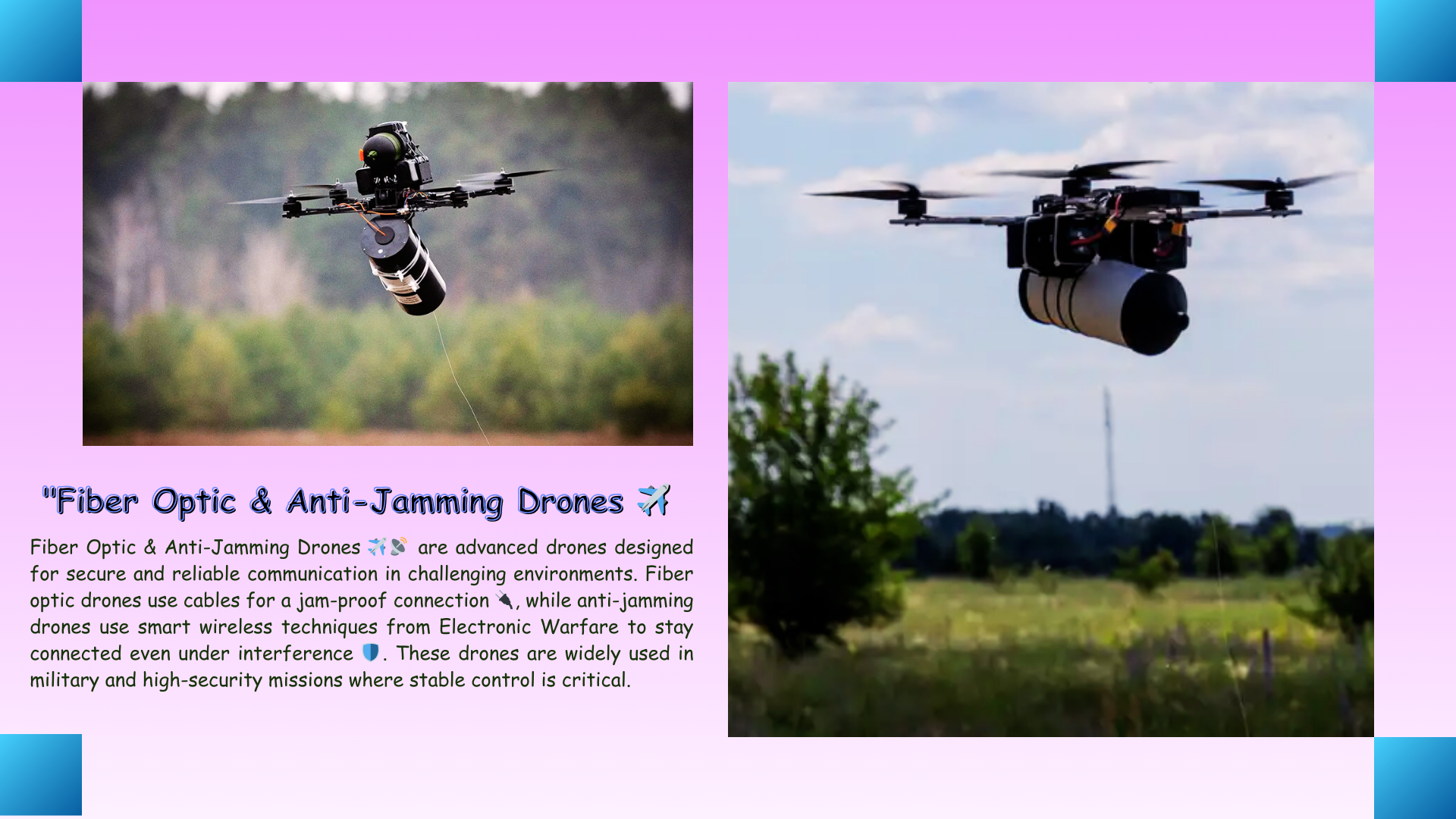
Fiber Optic Drones use physical cables for communication
Anti-Jamming Drones use smart wireless technologies to resist interference
Both are essential in modern defense and surveillance systems.
Fiber Optic Drones 🔌
Fiber optic drones are connected to the ground station through a fiber cable, rather than relying on radio signals.
⚙️ How They Work
Commands and data travel through a secure cable
No dependence on wireless signals
👉 Powered by Fiber Optics
⚡ Advantages
📡 Completely immune to signal jamming
🔐 Highly secure and hack-resistant
🛰️ Stable and uninterrupted communication
⚠️ Limitations
Limited range due to cable length
Restricted movement compared to wireless drones
Anti-Jamming Drones 🛡️
Anti-jamming drones are wireless drones designed to function even in electronically hostile environments.
⚙️ How They Work
Use frequency hopping to constantly change signals 🔁
Employ encrypted communication 🔐
Include backup navigation systems (AI-based)
👉 Based on Electronic Warfare techniques
⚡ Advantages
Resistant to signal jamming
Suitable for long-range missions
Reliable in war zones and high-risk areas
⚠️ Limitations
Not 100% jam-proof
More complex and expensive technology
Applications
🛡️ Military Operations – Secure missions in electronic warfare environments
🚧 Border Surveillance – Monitoring without signal interference
🎯 Counter-Drone Systems – Protecting airspace from threats
🏭 Critical Infrastructure – Security for power plants, bases, and sensitive areas
Advantages of These Technologies
Uninterrupted Communication 📡
High Security 🔐
Reliable Performance in Hostile Environments 🛡️
Essential for Modern Warfare and Surveillance ⚡
Challenges
High cost of development and deployment 💰
Technical complexity ⚙️
Limited range (for fiber optic drones)
Continuous need for upgrades against evolving threats
Conclusion
Fiber Optic & Anti-Jamming Drones ✈️📡 represent a major step forward in secure drone technology. By overcoming the limitations of traditional communication systems, these drones ensure reliable performance even in the most challenging environments. As electronic warfare and drone threats continue to evolve, these technologies will play a critical role in the future of defense, security, and advanced aerial operations.