 AETHERIUM
What is Immersive Reality?
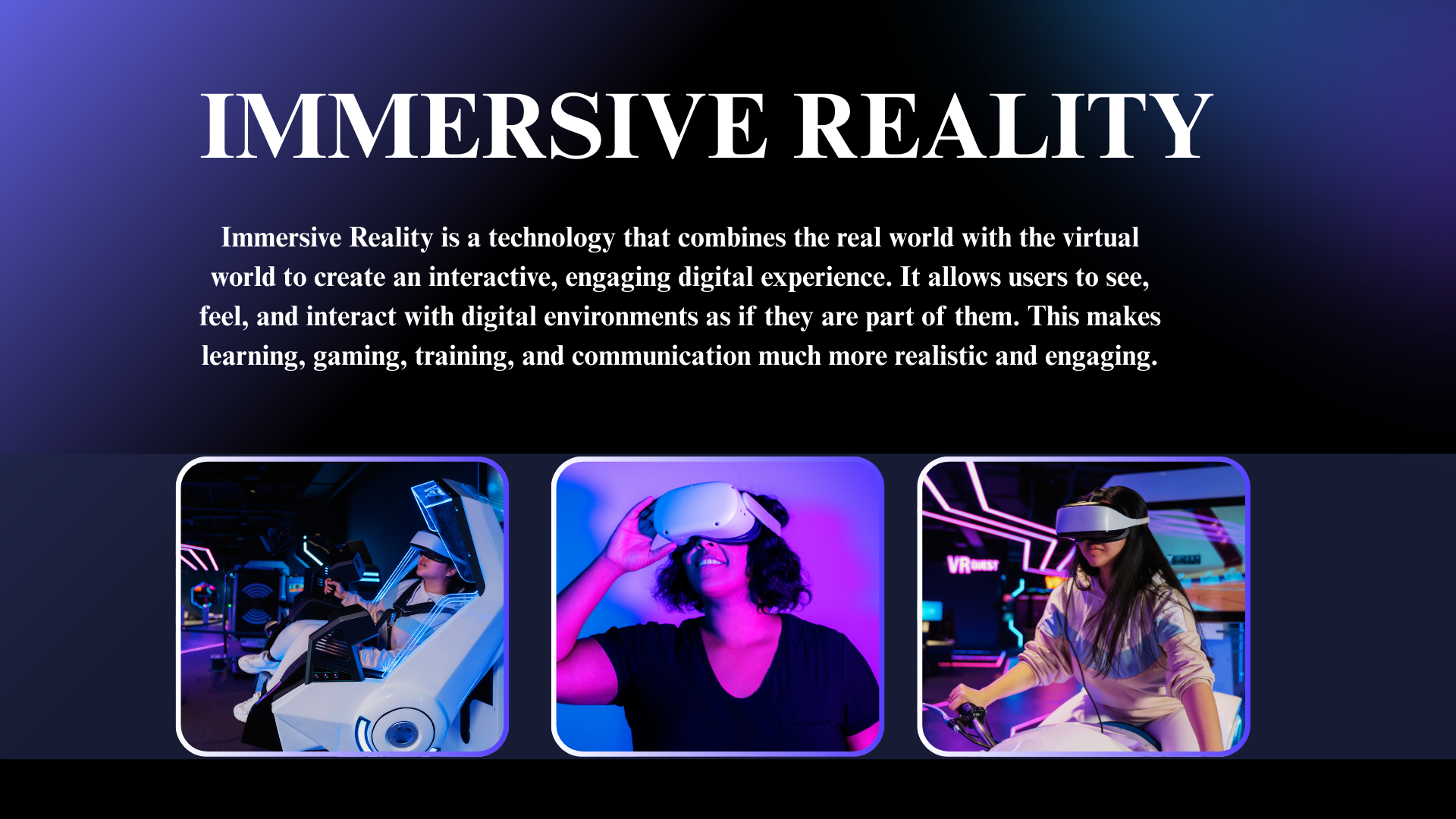
Immersive Reality is a technology that combines the real world with digital elements to create experiences where users feel as if they are actually inside a virtual environment. Unlike traditional screens or devices, immersive reality allows users to see, hear, and interact with digital content in a 3D space, making experiences more engaging and lifelike
Types of Immersive Reality
Immersive Reality is typically classified into three main categories:
1. Virtual Reality (VR)
Creates fully virtual environments that replace the real world.
Requires VR headsets to enter digital spaces.
Example: VR gaming, virtual tours, flight simulators.
2. Augmented Reality (AR)
Overlays digital objects or information onto the real world.
Example: Mobile apps like AR furniture placement apps, Pokémon Go.
3. Mixed Reality (MR)
Merges real and virtual objects that interact in real-time.
Example: Engineers visualizing digital prototypes in a real factory environment
Applications of Immersive Reality
1. Education 📚
Creates interactive learning environments with virtual labs and simulations.
Simplifies complex subjects using 3D visualizations and practical experience.
2. Gaming 🎮
Provides highly realistic and engaging experiences.
Players feel part of the game world, enhancing immersion and enjoyment.
3. Healthcare 🏥
Enables surgical simulations, patient training, and rehabilitation.
Reduces risk during training by offering virtual scenarios for practice.
4. Business & Industry 💼
Facilitates virtual meetings, collaboration, and product visualization.
Helps designers and engineers test prototypes virtually before production.
5. Training & Simulation 🚀
Pilots, military personnel, and industrial workers can train safely in simulated environments.
Reduces cost and danger compared to real-world training scenarios.
Benefits of Immersive Reality
Interactive Learning: Makes education more engaging and effective
Risk-Free Training: Provides safe environments for practice
Enhanced Collaboration: Supports teamwork and remote interaction
Improved Visualization: Helps in design, architecture, and industrial applications
Entertainment Value: Makes gaming and media experiences highly realistic
Future of Immersive Reality
The future of immersive reality is extremely promising. As VR, AR, MR, and AI technologies continue to advance, immersive experiences are becoming more realistic, accessible, and widely adopted.
In the next few years, we can expect:
Virtual classrooms and training centers for remote learning
Advanced gaming experiences with full body and sensory interaction
Healthcare solutions that allow doctors to simulate surgeries and treatments
Business collaboration platforms that replicate real-world meetings digitally
Ultimately, immersive reality is making technology more intuitive, interactive, and human-centric, creating a world where digital and real environments seamlessly blend.